六秒钟后你会恨死我这个题目,确实让人想看到第六秒到底发生什么。但系统这边只能读到图片,读不到正文,麻烦把文字版发上来。我先把恨意寄存,等你发来作文再决定要不要恨你。如果是微写作,我会按十分制拆开看;如果是长文,先告诉我体裁,我再决定走哪条批改线。等你。
Nuts and Bolts: “Thought” Verbs
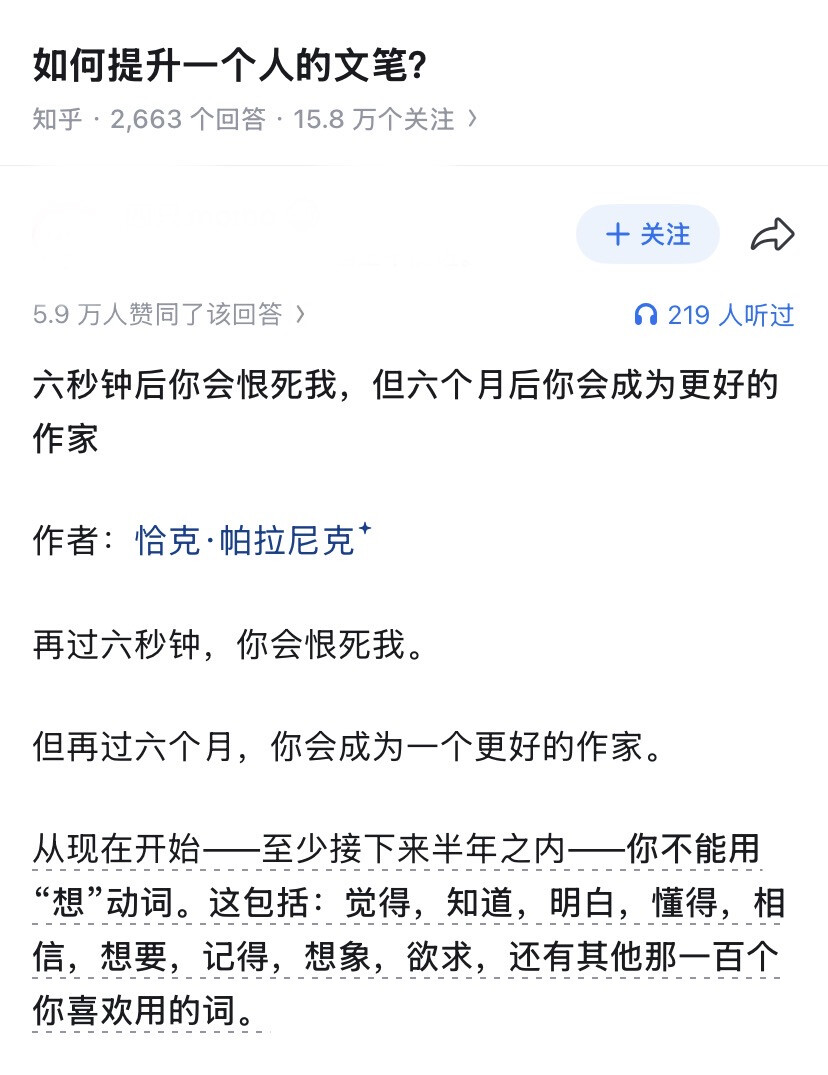
In six seconds, you’ll hate me.
But in six months, you’ll be a better writer.
From this point forward – at least for the next half year – you may not use “thought” verbs. These include: Thinks, Knows, Understands, Realizes, Believes, Wants, Remembers, Imagines, Desires, and a hundred others you love to use.
The list should also include: Loves and Hates.
And it should include: Is and Has, but we’ll get to those, later.
Until some time around Christmas, you can’t write: Kenny wondered if Monica didn’t like him going out at night…”
Thinking is abstract. Knowing and believing are intangible. Your story will always be stronger if you just show the physical actions and details of your characters and allow your reader to do the thinking and knowing. And loving and hating.
Instead, you’ll have to Un-pack that to something like: “The mornings after Kenny had stayed out, beyond the last bus, until he’d had to bum a ride or pay for a cab and got home to find Monica faking sleep, faking because she never slept that quiet, those mornings, she’d only put her own cup of coffee in the microwave. Never his.”
Instead of characters knowing anything, you must now present the details that allow the reader to know them. Instead of a character wanting something, you must now describe the thing so that the reader wants it.
Instead of saying: “Adam knew Gwen liked him.”
You’ll have to say: “Between classes, Gwen was always leaned on his locker when he’d go to open it. She’d roll her eyes and shove off with one foot, leaving a black-heel mark on the painted metal, but she also left the smell of her perfume. The combination lock would still be warm from her ass. And the next break, Gwen would be leaned there, again.”
In short, no more short-cuts. Only specific sensory detail: action, smell, taste, sound, and feeling.
Typically, writers use these “thought” verbs at the beginning of a paragraph (In this form, you can call them “Thesis Statements” and I’ll rail against those, later) In a way, they state the intention of the paragraph. And what follows, illustrates them.
For example:
“Brenda knew she’d never make the deadline. Traffic was backed up from the bridge, past the first eight or nine exits. Her cell phone battery was dead. At home, the dogs would need to go out, or there would be a mess to clean up. Plus, she’d promised to water the plants for her neighbor…”
Do you see how the opening “thesis statement” steals the thunder of what follows? Don’t do it.
If nothing else, cut the opening sentence and place it after all the others. Better yet, transplant it and change it to: Brenda would never make the deadline.
Thinking is abstract. Knowing and believing are intangible. Your story will always be stronger if you just show the physical actions and details of your characters and allow your reader to do the thinking and knowing. And loving and hating.
Don’t tell your reader: “Lisa hated Tom.”
Instead, make your case like a lawyer in court, detail by detail. Present each piece of evidence. For example:
“During role call, in the breath after the teacher said Tom’s name, in that moment before he could answer, right then, Lisa would whisper-shout: ‘Butt Wipe,” just as Tom was saying, ‘Here’.”
One of the most-common mistakes that beginning writers make is leaving their characters alone. Writing, you may be alone. Reading, your audience may be alone. But your character should spend very, very little time alone. Because a solitary character starts thinking or worrying or wondering.
For example: Waiting for the bus, Mark started to worry about how long the trip would take..”
A better break-down might be: “The schedule said the bus would come by at noon, but Mark’s watch said it was already 11:57. You could see all the way down the road, as far as the Mall, and not see a bus. No doubt, the driver was parked at the turn-around, the far end of the line, taking a nap. The driver was kicked back, asleep, and Mark was going to be late. Or worse, the driver was drinking, and he’d pull up drunk and charge Mark seventy-five cents for death in a fiery traffic accident…”
A character alone must lapse into fantasy or memory, but even then you can’t use “thought” verbs or any of their abstract relatives.
Oh, and you can just forget about using the verbs forget and remember.
No more transitions such as: “Wanda remember how Nelson used to brush her hair.”
Instead: “Back in their sophomore year, Nelson used to brush her hair with smooth, long strokes of his hand.”
Again, Un-pack. Don’t take short-cuts.
Better yet, get your character with another character, fast. Get them together and get the action started. Let their actions and words show their thoughts. You – stay out of their heads.
And while you’re avoiding “thought” verbs, be very wary about using the bland verbs “is” and “have.”
One of the most-common mistakes that beginning writers make is leaving their characters alone.
For example:
“Ann’s eyes are blue.”
“Ann has blue eyes.”
Versus:
“Ann coughed and waved one hand past her face, clearing the cigarette smoke from her eyes, blue eyes, before she smiled…”
Instead of bland “is” and “has” statements, try burying your details of what a character has or is, in actions or gestures. At its most basic, this is showing your story instead of telling it.
And forever after, once you’ve learned to Un-pack your characters, you’ll hate the lazy writer who settles for: “Jim sat beside the telephone, wondering why Amanda didn’t call.”
Please. For now, hate me all you want, but don’t use “thought” verbs. After Christmas, go crazy, but I’d bet money you won’t.
For this month’s homework
…pick through your writing and circle every “thought” verb. Then, find some way to eliminate it. Kill it by Un-packing it.
Then, pick through some published fiction and do the same thing. Be ruthless.
“Marty imagined fish, jumping in the moonlight…”
“Nancy recalled the way the wine tasted…”
“Larry knew he was a dead man…”
Find them. After that, find a way to re-write them. Make them stronger.
*Photo credit: Yasmina Moya

About the author
Chuck Palahniuk is author of the novels Fight Club, Survivor, Invisible Monsters, Choke, Lullaby, Diary, Haunted, Rant, Snuff, Pygmy, Tell-All, Damned, Doomed, and the upcoming Beautiful You. He also has two non-fiction books, the Portland travel memoir Fugitives & Refugees and the collection of true stories, essays, and interviews, Stranger Than Fiction.
基本功:思維動詞
六秒鐘後,你會恨死我。
但六個月後,你會成為一個更好的作家。
從此刻開始——至少在接下來的半年裡——你不能再使用「思維」動詞。這包括:想、知道、明白、意識到、相信、想要、記得、想像、渴望,以及其他幾百個你愛用的詞。
這份清單還應該加上:愛、恨。
它也應該包括:是、有,不過這些我們稍後再談。
在聖誕節到來之前,你不能寫:「肯尼納悶莫妮卡是不是討厭他晚上外出……」
思考是抽象的,知曉與信念是無形的。只要你展現出角色的具體動作與細節,讓讀者自己去思考、去知曉、去愛與恨,你的故事永遠會更有力。
相反地,你必須把它「拆解展開」,寫成類似這樣:「肯尼在外面待到末班車都開走了,只能搭便車或叫計程車回家。進門時,莫妮卡總在裝睡——之所以知道是裝的,是因為她平時睡覺從沒那麼安靜。在那些早晨,她只會把自己的那杯咖啡放進微波爐,絕不會放他的。」
不要讓角色去「知曉」任何事,你現在必須呈現具體細節,讓讀者自己去知曉;不要讓角色去「想要」某樣東西,你現在必須描繪那件物品,讓讀者自己產生渴望。
與其說:「亞當知道格溫喜歡他。」
你得說:「每逢課間,亞當去開儲物櫃時,格溫總是倚在上面。她會翻個白眼,一隻腳蹬著櫃門把自己推開,在漆過的金屬櫃面上留下一道黑色的鞋跟印,但也留下了她的香水味。密碼鎖上還殘留著她臀部的餘溫。而到了下一個課間,格溫又會倚在那裡。」
簡而言之,不再走捷徑。只用具體的感官細節:動作、氣味、味道、聲音和觸感。
通常,寫作者喜歡在段落開頭使用這些「思維」動詞(在這種結構下,你可以稱之為「主題句」,我稍後會痛批這一點)。在某種程度上,它們預告了該段落的意圖,而後續內容只是用來舉例說明。
例如:
「布蘭達知道自己絕對趕不上截止時間了。從大橋一路堵車,回堵了八九個出口。她的手機沒電了。家裡的狗需要帶出去遛,不然屋裡會被搞得一團糟。此外,她還答應了幫鄰居澆花……」
你看出開頭那句「主題句」是如何搶走後文所有細節的風頭了嗎?別這麼寫。
退一步講,就算不重寫,也把開頭那句話剪下來,放到所有細節之後。更理想的做法,是移過去並改寫成:布蘭達絕對趕不上截止時間了。
思考是抽象的,知曉與信念是無形的。只要你展現出角色的具體動作與細節,讓讀者自己去思考、去知曉、去愛與恨,你的故事永遠會更有力。
別告訴讀者:「麗莎恨湯姆。」
相反地,要像法庭上的律師一樣,一樁一件地列出細節,呈上每一樣證據。例如:
「點名時,就在老師念出湯姆名字後的換氣空檔,在湯姆開口回答的前一瞬,就在那當口,麗莎會壓低聲音喊:『擦屁布!』——恰好和湯姆嘴裡的『到!』撞在一起。」
初學者最常犯的錯誤之一,就是讓角色落單。寫作時,你可能是孤獨的;閱讀時,讀者可能是孤獨的;但你的角色應該極少、極少獨處。因為角色一旦孤身一人,就會開始思考、擔憂或胡思亂想。
例如:「在等公車時,馬克開始擔心這趟路程要花多久……」
更好的拆解方式是:「時刻表上寫著公車中午十二點會到,但馬克的手錶顯示已經 11 點 57 分了。順著馬路一眼望去,直到商場那麼遠,連一輛公車的影子都沒有。毫無疑問,司機肯定把車停在路線終點的調頭處睡大覺。司機正舒舒服服地仰頭大睡,而馬克要遲到了。或者更糟,司機喝了酒,待會兒滿身酒氣地把車停過來,收馬克七毛五分錢,載他奔向一場烈火熊熊的致命車禍……」
獨處的角色必然會陷入幻想或回憶,但即便如此,你也不能使用「思維」動詞或任何抽象的同類詞。
對了,你乾脆把「忘記」和「記得」這兩個動詞也徹底丟掉吧。
不要再出現這樣的過渡句:「萬達記得以前尼爾森是如何撫弄她的頭髮。」
改寫成:「回溯到大二那年,尼爾森總用手掌平整、修長地撫過她的秀髮。」
再次強調:拆解展開,別走捷徑。
更好的做法是:趕緊讓你的角色和另一個角色碰面。讓他們聚在一起,展開行動。用他們的動作和話語來展現他們的內心思維。至於你——離他們的腦袋遠一點。
在避開「思維」動詞的同時,也要對那些平淡無奇的動詞「是」和「有」保持高度警惕。
例如:
-
「安的眼睛是藍色的。」
-
「安有一雙藍眼睛。」
對比:
- 「安咳了一聲,一隻手在臉前揮了揮,在微笑之前,驅散了蒙住她雙眼——那雙藍眼睛——的香煙薄霧……」
與其使用平淡的「是」和「有」來陳述,不如嘗試將角色的特徵或擁有物埋藏在動作與姿態中。追根究底,這就是「展現而非告知」(Show, don’t tell)。
從今往後,一旦你學會了拆解角色,你就會厭惡那些敷衍了事的懶惰作者,比如寫出這種句子的人:「吉姆坐在電話旁,納悶阿曼達為什麼沒打過來。」
拜託了。現在你可以儘管恨我,但請不要使用「思維」動詞。等聖誕節過後,你愛怎麼寫就怎麼寫——但我敢打賭,到時候你絕不會再回頭了。
本月作業
翻出你自己的作品,圈出每一個「思維」動詞。接著,想辦法除掉它——透過「拆解展開」來幹掉它。
然後,去翻翻市面上出版的小說,做同樣的事。下手要狠。
-
「馬蒂想像著魚群在月光下躍出水面……」
-
「南希回憶起那款酒的滋味……」
-
「拉里知道自己死定了……」
找出它們。然後,想辦法重寫它們,讓它們更有力量。