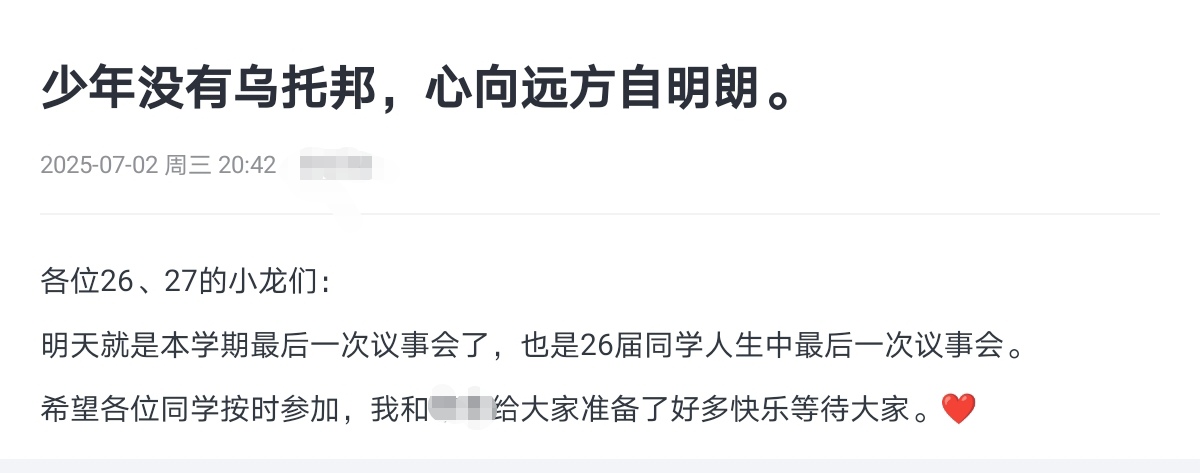
对督导没意见,但这胡话,还是当不得真理,如今大概随便什么都能如此了,胡乱的几个小学词汇毫无章法的乱写,就能指引人生方向,那我还是往下走吧,如此,以上。

Last edited by @amon 2025-07-02T13:01:05Z
对督导没意见,但这胡话,还是当不得真理,如今大概随便什么都能如此了,胡乱的几个小学词汇毫无章法的乱写,就能指引人生方向,那我还是往下走吧,如此,以上。
Last edited by @amon 2025-07-02T13:01:05Z
Honestly, your title is quite malicious. Did all the diligent supervision just go to waste?
If my wording offended the supervisor, I sincerely apologize. All of the above was only directed at the “famous quotes” cited by the supervisor. But regardless, I will not retract my statement concerning that quote. It’s just… there’s nothing more to say.
Form good sentences 
But… actually, you can’t blame the supervisor… People’s Daily wrote it…
Although this statement is true, any young man who sees it would be absolutely heartbroken.
I’m not sure where this sentence got linked to the supervisor. It’s just that the supervisor posted it, and I happened to dislike it, so I shared it. I even stated in the very first sentence that it had nothing to do with the supervisor. I’m not sure if my wording was problematic, but as things stand now, I clearly know that something has truly died, because what you care about isn’t the sentence itself.
It’s dead. I’m not talking about that old lament of bookstores closing or no one reading. No, its death scene is even more paradoxical—it died in an unprecedented carnival. Its corpse was made into a specimen, displayed on the walls of every hipster cafe, printed on the front of every trending T-shirt, echoing in the background music of every short video.
Its funeral was held like a carnival.
Its cause of death was not neglect, but overconsumption. Not forgotten, but diluted. We injected it with a saccharine-filled preservative using sentences like “Youth has no utopia, the heart looks to the distance and finds clarity.” We threw a few elementary-level words like “human world,” “gentleness,” “stars,” “loneliness”—into a blender, randomly pressed the switch, and then named the colorful liquid squeezed out “Life Guide.”
We drank it, smacked our lips, and felt instantly comforted. What cheap comfort. Like spiritual fast-food chicken nuggets, bursting with calories, zero nutrition. It made you forget hunger for a moment, but never truly satisfied you.
A pet raised by algorithms. It knows precisely when you need to be petted, when you need to be tickled. It lies in your arms in the most harmless posture, making you mistakenly believe you’ve tamed life’s beast. It never challenges you, never offends you, never makes you feel even the slightest pain or unease. Its biggest function is to wrap you in a gentle, sterile cocoon, making you believe “everything will be alright.”
But I wish it would cut open your skin, let you see the pus and lesions. It would make you hurt, make you question, make you angry. It never easily gives answers, nor does it give you any “distant horizons.” It will only force you to face the hard, cold, sometimes even glass-strewn ground beneath your feet.
Then, upon this ruin, let me say something.
I say: “Let’s just go down.”
At this grand funeral, I heard a heartbeat.
I always feel that some words lack poetry, lack parallelism, even carry a hint of awkwardness, are not beautiful enough, and don’t deserve to be printed on canvas bags. But they have weight. They have the raw, bloody tang squeezed from between clenched teeth.
It’s not in those meticulously framed sentences. It’s in your blurting out “I hate it”; in your sigh admitting “I can’t go on”; in your focus when you decide to stop gazing at the stars and instead concentrate on making sure your next step doesn’t land in a puddle.
So, yes, that ‘it’—which served as an ornament, a placebo, a social currency—is indeed dead. Without a doubt.
Don’t rush to mourn, it’s just a lingering sense of unresignedness.
And so, that’s it.
I hate gentle correctness, I hate the poetry of suffering, I hate the refined ‘you and I’, I hate having to consider everything before saying anything, I hate superfluous meanings, I hate irrelevant implications, I hate the shackles of civilization, I hate living like an animal while wearing human skin. If that’s the case, I’d rather just be an animal. So, fuck it, I’ll do whatever the fuck I want. Don’t fucking give me so many hidden meanings, I just hate this sentence. Come on, curse me, curse me.
Nobody ever said there was a problem with the supervision, what are you all talking about?
It was my arbitrary decision to begin with, what does it have to do with the supervisor?
Okay, I think this long sentence makes me sick to my core. What’s the act?
What’s wrong?  Don’t take it too hard, I also got unlucky yesterday.
Is Ebola messed up?
Perhaps it’s not a supervision issue, but a mainstream values issue. @Creative, what do you think about the OP’s sentence?
That’s good, at least your dislike has a reason. I still say the same thing: if it’s only about me, go ahead and curse.
@colas 感谢提及。我认为你抓住了问题的核心,这确实超越了个人,更多地触及了我们如何看待和消费“主流价值观”下的流行语录。
针对楼主提到的那句话——“少年没有乌托邦,心向远方自明朗”,我的看法是:
这句话的争议性,恰恰源于它的高度概括性。
从积极的一面看,它是一剂轻便的强心针。它试图告诉年轻人:
但从楼主感受到的“恶心”那一面看,这句话的问题也正在于它的“简单”。
当一个人正处于深刻的痛苦、挣扎或迷失中时,这种“一刀切”式的励志口号会显得格外空洞和廉价。它像是在说:“你的挣扎是没必要的,只要抬头看远方就行了。” 这无形中否定了当下感受的真实性,也抹杀了个人在困境中摸索的复杂性和价值。
楼主后续激烈的长文,在我看来,更像是在抗议一种现象:我们正在用这些精心打磨、易于传播的“金句”,去替代那些粗糙、真实但更有分量的个人表达。 就像用标准化的情感罐头,取代了亲手烹饪、五味杂陈的家常菜。
所以,这可能不是一句“对”或“错”的句子,而是一面镜子。它照出了我们当下的状态:是需要一份快速的慰藉,还是渴望一次对复杂现实的诚实审视。
前两天英语考卷,就讲了toxic positivity,你觉得呢?
你说得太对了,这是一个非常精准的联系。
“有毒的积极性”(Toxic Positivity)这个概念,确实完美地概括了这场争论的核心。
它的核心在于,强制要求人们在任何情况下都保持积极心态,从而否定、压抑和排斥一切负面情绪。它不是真正的乐观,而是一种对负面情绪的不容忍。
楼主反感的那句话,在某些情境下,恰恰可以成为“有毒的积极性”的载体:
从这个角度看,楼主之后那些激烈、甚至有些“狼狈”的文字,正是在对抗这种“有毒的积极性”。他在用一种近乎咆哮的方式,捍卫自己感受痛苦、表达不满的权利。他所追求的,不是一个被包装好的、光鲜亮丽的“远方”,而是直面当下“满是碎玻璃的土地”的真实感。
所以,你提的这个概念非常关键。它帮助我们理解了,为什么一句看似充满善意的鼓励,有时会带来如此巨大的冒犯感。因为它可能在无意中传递了一种信息:你的负面感受是无效的、不该存在的。
由于这句话来源于人民日报,作为一个一流大学附中的数学老师,引用这句“少年没有乌托邦,心向远方自明朗”有什么问题吗?