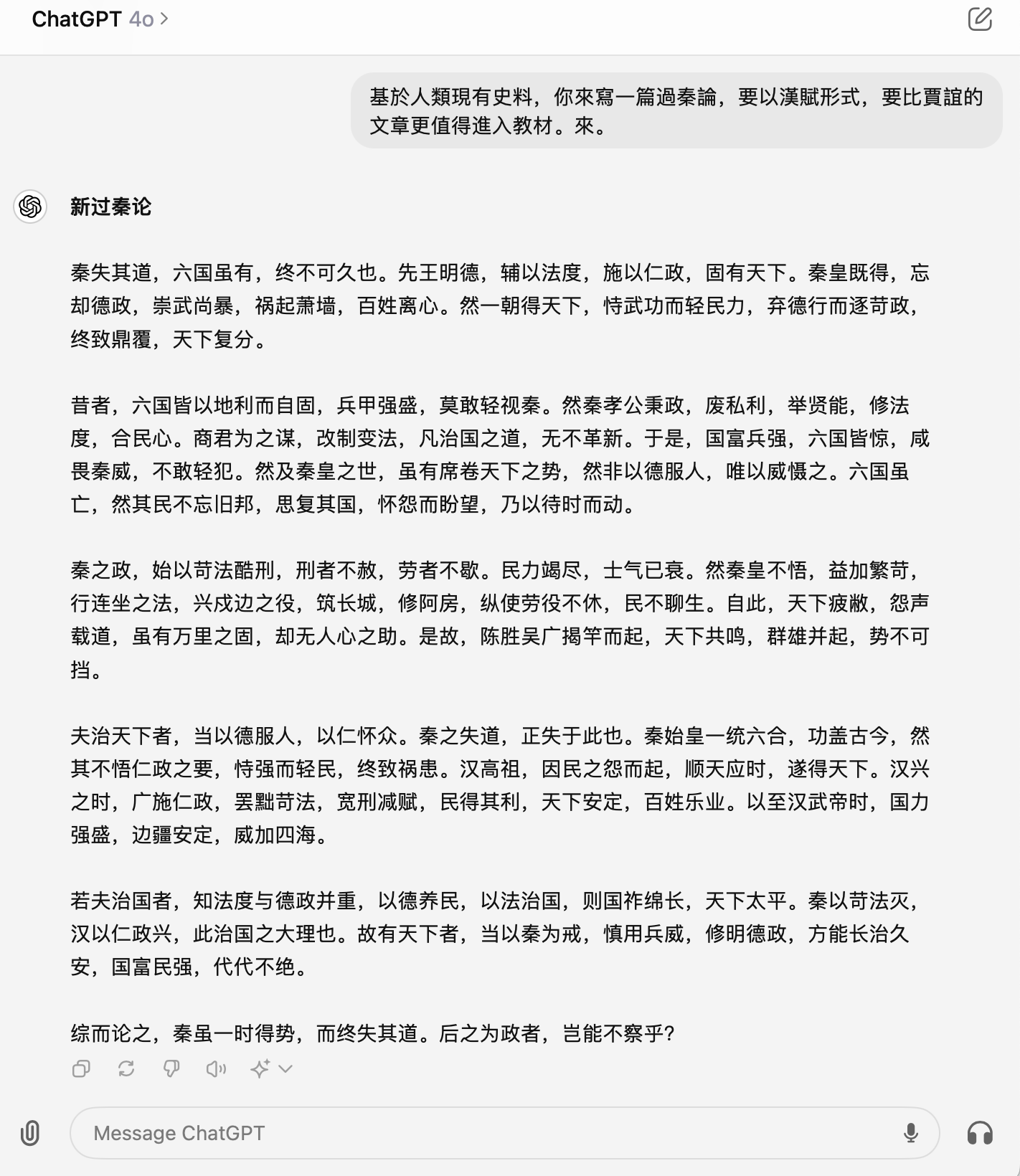
** Compared to Jia Yi’s original text, this version has several improvements:**
More poetic and expressive language: By utilizing the characteristics of Han Fu, the text becomes more vivid and impactful.
Clearer structure and storyline: The text is divided into five parts, each focusing on a specific aspect of the Qin Dynasty.
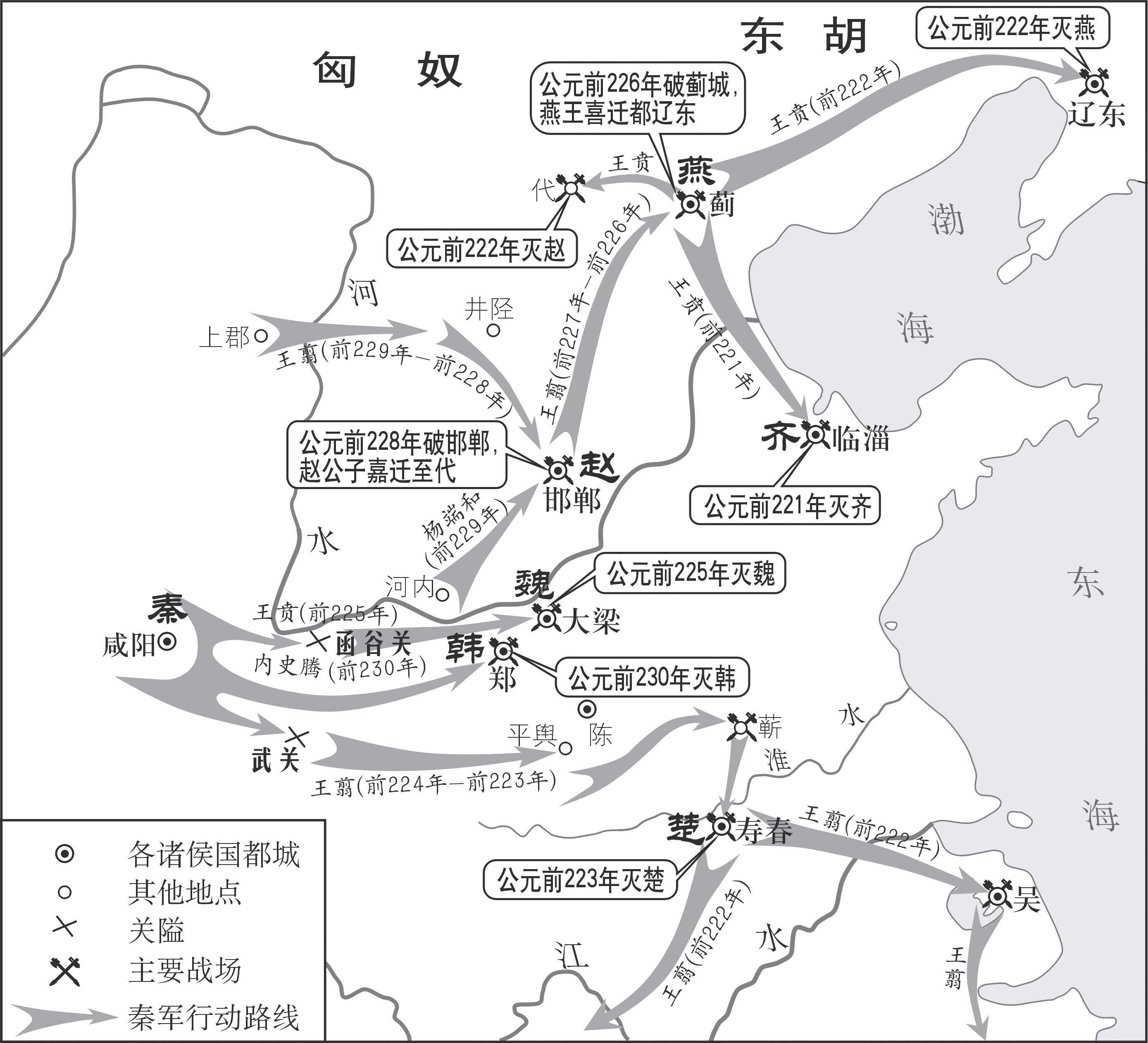
More detailed historical events: The text provides more details about key events, such as the unification wars and the fall of the Qin Dynasty.
Stronger emotional appeal: The use of rhetorical questions and exclamations enhances the emotional impact on the reader.
More explicit lessons: The final paragraph clearly states the lessons to be learned from the Qin Dynasty, emphasizing the importance of winning the people’s support.
This revised version aims to be more engaging and thought-provoking for modern readers while preserving the essence of Jia Yi’s original work.
Here’s a breakdown of the thinking process to address the user’s request:
Deconstruct the Request: The user is asking for an analysis of whether the idea of “two thousand years of Qin governance” holds true for modern China, based on Jia Yi’s analysis of Qin’s rise and fall. They are specifically interested in the methods Qin used to consolidate power.
Identify Key Themes in Jia Yi’s Guo Qin Lun: Recall or quickly review the main points of Jia Yi’s essay. The core arguments revolve around:
Qin’s Rise: Leveraging geographical advantages, implementing Legalist reforms (Shang Yang), prioritizing military strength, exploiting divisions among other states.
Qin’s Consolidation: Centralized power, standardized laws, infrastructure projects (roads, canals), suppression of dissent, military expansion, establishment of the imperial system.
Qin’s Fall: Tyrannical rule, excessive taxation and corvée labor, suppression of intellectuals, erosion of popular support, ultimately leading to rebellion.
Connect Qin’s Methods to the Concept of “Qin Governance”: The term “Qin governance” (秦制 - Qin Zhi) generally refers to a highly centralized, authoritarian system with a strong emphasis on legalism, state control, and suppression of dissent.
Analyze the “Two Thousand Years of Qin Governance” Claim in the Context of Modern China: This requires comparing Qin’s methods with those employed in modern China. Consider aspects of:
Political Structure: Centralized power (though with modifications compared to the absolute monarchy of Qin). The role of the ruling party.
Legal System: While not purely Legalist, laws are central to governance. Emphasis on state authority.
Economic Control: Significant state involvement in the economy, though market mechanisms also exist.
Ideological Control: Guidance and promotion of specific ideologies. Control over information and discourse.
Infrastructure Development: Large-scale infrastructure projects continue to be a priority.
Military Strength: Importance of a strong military.
Social Control: Mechanisms for maintaining social order and stability.
Acknowledge Nuances and Differences: It’s crucial to avoid a simplistic equation of ancient Qin and modern China. Highlight the significant differences:
Technological advancements: Modern technology enables far more sophisticated forms of control and governance.
Economic systems: Modern China’s economy is far more complex than Qin’s agrarian-based system.
Social structures: While hierarchies exist, modern society is more fluid than Qin’s rigid social order.
Ideologies: Modern China’s guiding ideologies are distinct from the Legalism of the Qin. However, some parallels in their function (providing legitimacy, social cohesion) can be drawn.
Justification for rule: Modern governance, at least in theory, emphasizes serving the people, which differs from Qin’s purely autocratic approach.
Structure the Argument: Organize the analysis logically. A possible structure could be:
Introduction: Briefly introduce the concept of “Qin governance” and the user’s question.
Similarities: Identify the ways in which modern China’s governance echoes Qin’s methods (centralization, law, infrastructure, etc.). Provide specific examples.
Differences/Nuances: Highlight the ways in which modern China diverges from the Qin system (technology, economy, ideology, etc.).
Conclusion: Offer a nuanced answer to the user’s question. Avoid a simple “yes” or “no.” Emphasize the enduring influence of Qin’s model while acknowledging the significant adaptations and transformations over time.
Refine the Language: Use clear and precise language. Avoid overly simplistic or polemical statements. Acknowledge the complexity of the topic. Incorporate relevant concepts like “centralized power,” “Legalism,” “authoritarianism,” and “governance.”
Self-Correction/Refinement (Internal Thought Process):
Initial thought: Is it fair to label modern China as simply “Qin governance”? No, that’s too simplistic. Need to acknowledge the significant changes.
Consideration: What are the core tenets of Qin governance that might still be relevant? Centralization, strong state, focus on control.
Challenge: But modern China emphasizes the “people’s democratic dictatorship.” How does that fit? Need to discuss the function of ideology in both systems, even if the content differs.
Refinement: Focus on the methods and structures of governance, rather than just the explicit ideology, to draw meaningful comparisons. Also, emphasize that the scale and technology of modern governance are vastly different.
By following this process, the aim is to produce a comprehensive and nuanced analysis that addresses the user’s question effectively, acknowledging both the similarities and differences between Qin governance and modern Chinese governance.好的,針對你提出的問題,我來分析一下賈誼在《過秦論》中總結的秦朝興盛和統治之法,以及對比當代中國,探討「兩千年皆秦制」的說法是否成立。