不评完不能开希悦,谁有时间细想哪个老师好
5 Likes
问题根源肯定不在学生,阐述事实罢了
学生只是必然的一环
2 Likes
唉
3 Likes
这不是ai我吃(
3 Likes
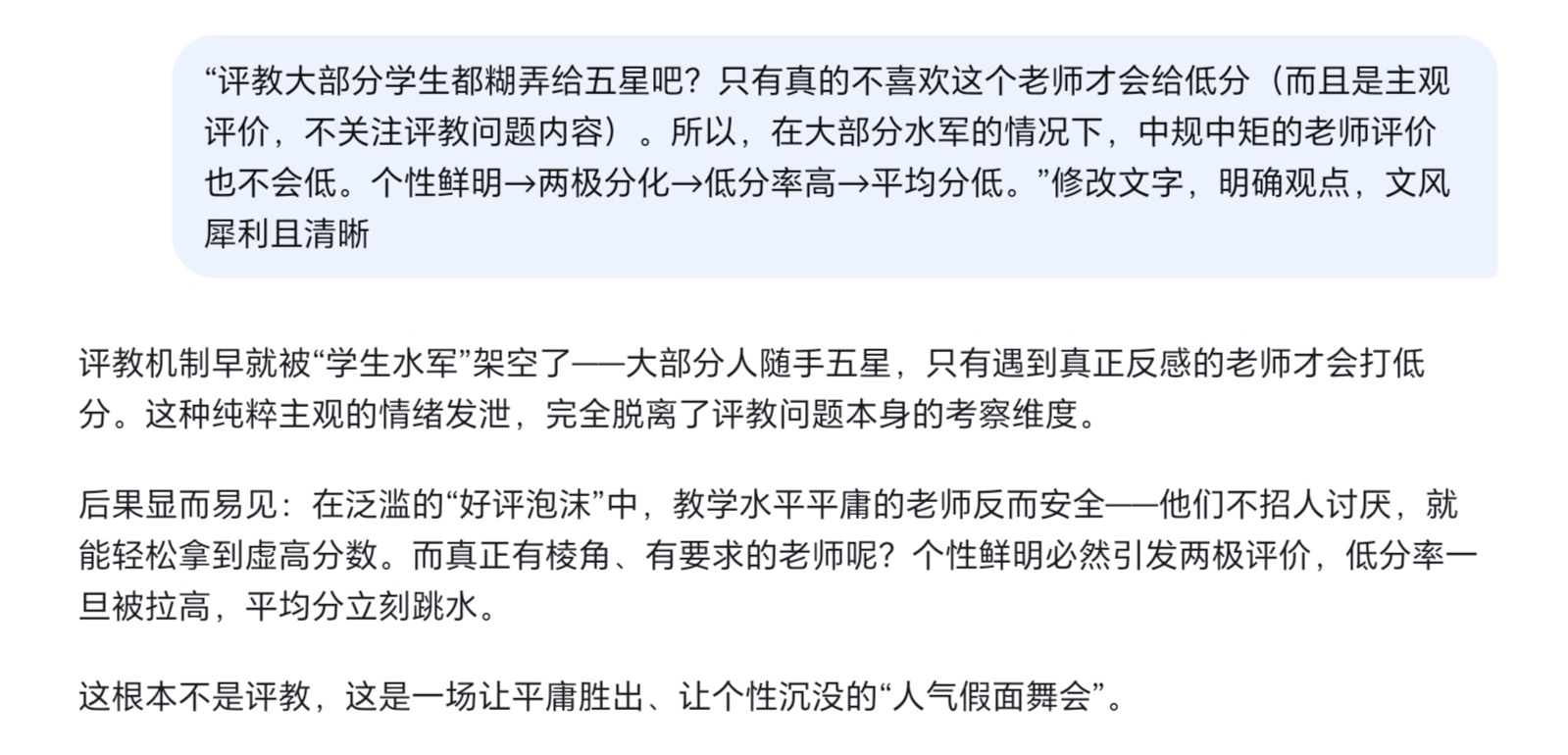
你不用吃了。嗯
2 Likes
不是针对你哈,个人对ai味很冲的文本会有生理性的反感,建议至少文风别太像ai(
4 Likes
企微开盒还是太好用了。原来是GW3小登
2 Likes
理解,AI文风会让人直接联想到一键生成大量文字,失去交流的真诚,会引起反感。但听我狡辩:不知道正常说话是否能被听懂,所以用AI明确一下文字,方便阅读,观点是真实的!总之,接受建议!
4 Likes
Why AI Detectors Fail: Penalizing the Writers Who Follow the Rules
Hojeannie C
Published Mar 19, 2025
Finding my voice after years of business writing training makes my content indispensable from AI.
Last year, in June, I embarked on an EMBA journey. It was an interesting time to restart school, with the landscape of education changing rapidly due to the rise of AI. It was almost nostalgic—reminiscent of my college days when the landscape of computer science evolved dramatically over my four years there.
If you did the math in your head, that means I started school after 8–9 years in the industry. And as a product/program manager, that’s 8–9 years of training to write… in today’s terms, like AI. I’ve scoured writing books on business proposals and even held a recurring writing seminar on how to formulaically craft successful business papers. Always use active voice. Eliminate weasel words—those “unnecessary” adjectives and adverbs. Triple-check grammar. Provide a data point for 75% of the content. Keep it short, succinct, and clear. Minimize style, voice, and tone. Business proposals, in a sense, are just structured write-ups of hard data, conviction, and persuasive techniques. Lean on company principles, credibility, and logic—none of the emotional stuff.
Well, in my first year of the program, I got dinged—hard—for this writing style, the same one that had shaped my success for eight years. Especially in Marketing. I failed the “human check” on new auditing tools designed to detect AI-generated text. The “human” versions, which I even paid extra for someone to review, were, in my opinion, terrible writing—too flowery, overly descriptive, unclear, and vague. It would never fly in my work. Nor would it successfully convince my incredibly intelligent peers.
And I’m not alone in this. A professional writer recounted a similar experience when an editor flagged their article as AI-generated, despite it being 100% human-written (Catalyst). If an actual professional writer can’t pass the test, what hope is there for the rest of us? Even more absurd, these tools have mistakenly identified the U.S. Constitution and the Bill of Rights as AI-generated (Reddit). Let that sink in—foundational texts, written centuries ago, somehow classified as machine-generated nonsense.
The same happened with my applications. I wrote the way I was trained to: stating my reasoning, logic, and proposal, then refining it for clarity and conciseness. The verdict? My writing was AI-generated.
This issue is even worse for non-native English speakers. A Stanford study found that while AI detectors were “near-perfect” in evaluating essays written by U.S.-born eighth-graders, they classified more than half (61.22%) of TOEFL essays written by non-native English students as AI-generated (Stanford HAI). Imagine putting in the effort to write an original paper in a second language, only to have an algorithm dismiss it as artificial because it doesn’t fit the nebulous criteria of what’s deemed “human” writing.
So what exactly is “human” text? Is it categorized as emotional writing with lots of style, voice, and adjectives—some haze of ambiguity? Because in the tech world, where logic, reasoning, and structured persuasion techniques are followed formulaically, I don’t see that style successfully convincing stakeholders. Emotional arguments were discouraged in my writing for nearly a decade (if you count my research years in undergrad), so how am I suddenly expected to shift my writing to fit this AI-identified “human” categorization? Especially when I fundamentally disagree with the auditors’ definition of “human” writing?
I believe the education system’s auditing mechanisms should focus on fact-checking written content—cross-referencing facts across papers to detect identical sources or verifying the originality of insights and analysis. But assessing “humanity” based on writing style alone is fundamentally flawed. It disregards the principles of effective business and technical writing—the same rules both LLMs and professionals were trained to follow. So why should only humans be penalized for adhering to them?
I’ve started writing more—not just to leave artifacts of my work, but to practice the rules I’ve painstakingly learned over the years. Especially in a world where I feel unfairly penalized for “following the rules of writing too well.”
Works Cited
Catalyst, Write A. “My Content Was Falsely Flagged as AI-Written. Here’s What I Did About It.” Medium, 2023, https://medium.com/write-a-catalyst/my-content-was-falsely-flagged-as-ai-written-heres-what-i-did-about-it-e428b1139742.
Reddit User. “AI Detectors Have False Positives, Such as Saying That US Constitution or Bill of Rights Were AI Written.” Reddit, 2023, Reddit - The heart of the internet.
Stanford HAI. “AI Detectors Are Biased Against Non-Native English Writers.” Stanford Institute for Human-Centered AI, 2023, https://hai.stanford.edu/news/ai-detectors-biased-against-non-native-english-writers.
4 Likes
还真是,论坛里面看到首字母就忍不住点开企微
3 Likes
你好老登,注册初期就没有怕被开盒,无恶意的都能接受
11 Likes
这种专业的文风即使ai生成我也能接受,最难受的是ds的浮夸风论述和gemini的谷八股叙事
7 Likes
@neochat 全文翻译并总结
2 Likes
好家伙,让AI翻译AI检测器的文章,套娃了属于是
2 Likes
无恶意。只是作为两年GW3老兵,确实感慨自己已经远离西楼了
5 Likes
这里面的3个链接,都可以直接访问诶。看起来是直接用的阿里云oss的链接,访问权限是公开的,没有额外权限验证
4 Likes
替換姓名:)
2 Likes
确实可行,但是为什么我们的老师的都不存在,高三是分开的?
2 Likes
哦,这个是上学期的
5 Likes