Last edited by @suen 2025-06-22T00:35:48Z
@Creative
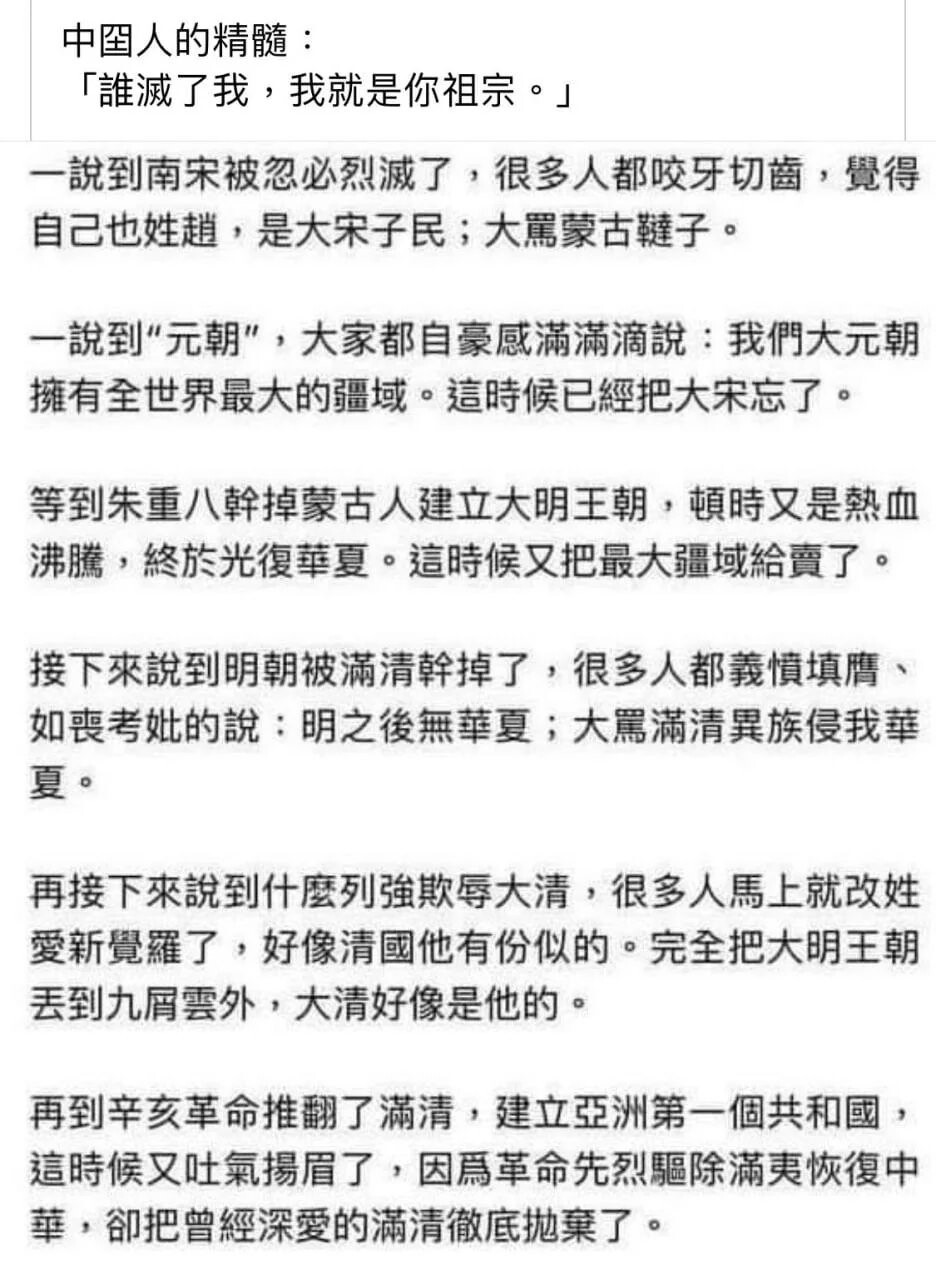
一說到南宋被忽必烈滅了,很多人都咬牙切齒,覺得
自己也姓趙,是大宋子民;大罵蒙古韃子。
一說到“元朝”,大家都自豪感滿滿滴說:我們大元朝
擁有全世界最大的疆域。這時候已經把大宋忘了。
等到朱重八幹掉蒙古人建立大明王朝,頓時又是熱血
沸騰,終於光復華夏。這時候又把最大疆域給賣了。
接下來說到明朝被滿清幹掉了,很多人都義憤填膺、
如喪考妣的說:明之後無華夏;大罵滿清異族侵我華
夏。
再接下來說到什麼列強欺辱大清,很多人馬上就改姓
愛新覺羅了,好像清國他有份似的。完全把大明王朝
丟到九屑雲外,大清好像是他的。
再到辛亥革命推翻了滿清,建立亞洲第一個共和國,
這時候又吐氣揚眉了,因為革命先烈驅除滿夷恢復中
華,卻把曾經深愛的滿清徹底拋棄了。
評析以上觀點
This viewpoint presents a cynical and generalized perspective on the shifting allegiances of Chinese people throughout history, suggesting a lack of deep-rooted loyalty and a tendency to embrace whoever is in power. It uses historical dynasty changes as examples to illustrate this point, summarized by the opening statement: “Whoever destroys me, I will recognize as my ancestor.”
Let’s break down the points and offer a critique:
Points Presented in the Text:
- Southern Song Dynasty - Yuan Dynasty: The text suggests that while people initially mourned the fall of the Southern Song to the Mongols (Yuan Dynasty), they quickly shifted to boasting about the Yuan’s vast territory, forgetting their previous allegiance to the Song.
- Yuan Dynasty - Ming Dynasty: When Zhu Yuanzhang (Hongwu Emperor) overthrew the Yuan and established the Ming, people supposedly became nationalistic again, celebrating the “restoration of Han Chinese” and discarding the Yuan’s legacy.
- Ming Dynasty - Qing Dynasty: The text claims that upon the Qing (Manchu) conquest of the Ming, people lamented the loss of “Hua Xia” (Chinese civilization) and condemned the Qing as foreign invaders.
- Qing Dynasty - Era of Western Powers: However, when facing foreign aggression against the Qing, the text argues that people suddenly identified with the Qing, seemingly forgetting their Ming loyalties and treating the Qing as “their own country.”
- Qing Dynasty - Republic of China: Finally, with the Xinhai Revolution overthrowing the Qing and establishing the Republic, people celebrated the expulsion of the Manchus and the restoration of China, completely abandoning their previous Qing affiliation.
Critique of the Viewpoint:
-
Oversimplification and Generalization: The text paints a very broad and simplistic picture of “Chinese people” as a monolithic entity with easily swayed loyalties. It ignores the complexities of individual and regional identities, varying levels of political awareness, and the diversity of opinions within each historical period. It’s unlikely that all or even most people uniformly shifted their allegiances in such a straightforward manner.
-
Ignoring Nuance and Context: The text lacks historical nuance. People’s reactions to dynastic changes were far more complex than simply switching loyalties for convenience. Factors influencing people’s attitudes included:
- Survival: In times of dynastic change and war, survival was often the primary concern for ordinary people. Adapting to the new regime could be a matter of necessity.
- Pragmatism: Recognizing and cooperating with the ruling power was often a pragmatic way to maintain order and stability in their lives.
- Propaganda and Control: New dynasties actively worked to legitimize their rule and suppress dissent. They often used propaganda to shape public opinion and encourage loyalty.
- Ethnic and Cultural Identity: While the text touches upon Han Chinese identity, it oversimplifies the complex interplay of ethnic and cultural identities throughout Chinese history. Reactions to “foreign” dynasties were varied and evolved over time.
- Long-term vs. Short-term Perspectives: The text seems to focus on immediate reactions to dynastic change. Longer-term historical perspectives might reveal more consistent cultural and national identities that persisted despite dynastic shifts.
-
Cynical and Negative Tone: The viewpoint is inherently cynical and negative, portraying Chinese people as opportunistic and lacking genuine conviction. This is a harsh judgment and may reflect a biased or overly critical perspective.
-
Ignoring Resistance and Dissent: The text’s narrative downplays or ignores instances of resistance, rebellion, and enduring loyalty to previous dynasties. Throughout history, there were always groups who maintained loyalty to overthrown regimes, even at great personal cost. Examples include Ming loyalists resisting the Qing, or Song loyalists resisting the Yuan.
Alternative Perspectives:
- Adaptability and Resilience: Instead of seeing it as fickleness, one could interpret these shifts in allegiance as a testament to the Chinese people’s adaptability and resilience in the face of constant political upheaval. Their focus might have been on maintaining social order and cultural continuity regardless of who held power.
- Evolution of National Identity: The concept of “national identity” itself is not static. It evolves over time and is shaped by historical events. The shifts in allegiance could be seen as part of this ongoing process of identity formation in China.
- Focus on “China” as a Civilization: Perhaps the underlying loyalty was not necessarily to a specific dynasty, but to the idea of “China” as a civilization and a cultural entity, which transcended dynastic changes.
In conclusion, while the text raises an interesting point about the fluidity of allegiance in Chinese history, it presents a highly cynical, oversimplified, and generalized view. It’s important to approach such perspectives with critical thinking and consider the complex historical, social, and psychological factors that shaped people’s attitudes towards dynastic changes. A more nuanced understanding requires acknowledging the diversity of opinions, the constraints of historical context, and the potential for alternative interpretations beyond simple fickleness.
不是所有人都支持该观点的,现在声势最浩大的意识形态之一的皇汉就不认同元清。(这群人是反少民的汉民族主义者)